
Uncategorized
how does bromantane work
How Does Bromantane Work? A Research Overview
How does Bromantane work? Scientific research has investigated its relationship with dopamine synthesis, dopamine uptake, tyrosine hydroxylase, DOPA-decarboxylase and serotonergic signalling. However, Bromantane’s complete mechanism of action remains unresolved.
Bromantane appears to interact mainly with dopaminergic pathways.
Experimental research suggests that Bromantane may influence dopamine through several mechanisms, including changes in dopamine release and uptake and regulation of enzymes involved in dopamine biosynthesis. Animal research has also identified effects involving serotonin systems. These mechanisms remain areas of scientific investigation rather than a completely established explanation of Bromantane’s actions in humans.
Is Bromantane’s Exact Mechanism of Action Known?
The short answer is no.
Although several studies provide clues about how Bromantane works, the scientific literature does not establish one simple, fully understood mechanism that explains all of its reported experimental effects.
Research has focused particularly on the dopaminergic system, with additional investigation involving serotonin and other neurological pathways.
This is important because simplified descriptions such as “Bromantane increases dopamine” do not capture the complexity of the available evidence.
Demonstrating an effect on a neurotransmitter, enzyme or gene in an experimental model does not automatically establish a specific cognitive, therapeutic or behavioural outcome in humans.
How Does Bromantane Affect Dopamine?
Dopamine is the neurotransmitter system most consistently associated with Bromantane in experimental research.
A 1995 animal study examined the effects of Bromantane on dopamine, serotonin and their metabolites in several regions of the rat brain. The researchers concluded that the dopaminergic system appeared to play an important role in the compound’s pharmacological effects.
Subsequent studies investigated this relationship in greater detail, examining dopamine release, dopamine uptake and the expression of genes involved in dopamine biosynthesis.
Experimental studies have investigated changes in dopamine release and metabolism following Bromantane exposure.
Laboratory research has reported inhibition of dopamine synaptosomal uptake under experimental conditions.
Animal studies investigated genes encoding key enzymes involved in dopamine biosynthesis.
Other animal research has explored dopamine-dependent mechanisms involved in neuronal and synaptic responses.
Bromantane and Dopamine Synthesis
One particularly interesting area of Bromantane mechanism research involves the biochemical pathway used by neurons to produce dopamine.
In simplified form, dopamine synthesis involves conversion of the amino acid tyrosine into L-DOPA, followed by conversion of L-DOPA into dopamine.
Research using Ladasten, a name associated with Bromantane, examined expression of genes responsible for tyrosine hydroxylase and DOPA-decarboxylase.
A 2004 animal study reported changes in expression of these genes alongside changes in L-DOPA and dopamine concentrations in selected regions of the rat brain.
What Is Tyrosine Hydroxylase and Why Does It Matter?
Tyrosine hydroxylase, commonly abbreviated as TH, is a key enzyme involved in catecholamine biosynthesis.
In the dopamine pathway, it participates in conversion of tyrosine into L-DOPA and is commonly described as a rate-limiting step in dopamine synthesis.
Several animal studies involving Ladasten investigated TH at the level of gene expression, protein levels or enzyme-related activity.
A 2006 rat study reported increased TH gene mRNA following a single Ladasten exposure and investigated changes in DNA methylation within regulatory regions of the tyrosine hydroxylase gene.
The authors proposed that changes in gene regulation could be involved in increased TH transcriptional activity observed in their experimental model.
Does Bromantane Affect Dopamine Uptake?
Dopamine signalling does not depend only on how much dopamine is synthesised. Neurons also regulate dopamine through release, receptor activity, reuptake and metabolism.
A 1999 paper examining the neurotropic mechanisms of Bromantane reported inhibition of dopamine synaptosomal uptake at 50 micromolar under the experimental conditions used by the researchers.
This finding is one reason dopamine uptake appears in mechanistic discussions of Bromantane.
However, an effect observed in an isolated experimental preparation should not automatically be interpreted as describing the compound’s dominant mechanism in a living human.
Bromantane, Dopamine and Synaptic Plasticity
Research has also examined Ladasten in relation to synaptic plasticity.
A rat study investigated catecholamine biosynthesis in several brain regions and then examined synaptic plasticity within hippocampal preparations.
The researchers reported changes involving tyrosine hydroxylase, dopamine and L-DOPA alongside alterations in experimentally measured synaptic potentiation.
The synaptic effects were influenced by a dopamine D1/D5 receptor antagonist in the experimental model, supporting the authors’ interpretation that dopamine-dependent mechanisms were involved.
Does Bromantane Affect Serotonin?
Dopamine receives most of the attention, but serotonin has also been investigated.
In the 1995 rat study, researchers measured serotonin and 5-hydroxyindoleacetic acid across several brain regions after acute and repeated Bromantane administration.
The results varied according to the brain region examined.
A later mechanistic paper also reported effects involving serotonin uptake and serotonergic responses in animal models.
These findings suggest that Bromantane’s experimental effects may not be exclusively dopaminergic.
Neurotransmitter systems interact with one another. A compound that changes one dopamine or serotonin measurement in an experimental model cannot necessarily be described accurately with a simple “raises dopamine” or “raises serotonin” label.
Is Bromantane’s Mechanism the Same as Typical Stimulants?
Bromantane is often discussed alongside stimulants, but the scientific literature describes a mechanism that does not map neatly onto the simplified mechanisms commonly associated with traditional psychostimulants.
Researchers studying Bromantane have investigated not only monoamine uptake but also gene expression and dopamine biosynthesis.
This has led researchers to investigate Bromantane as an unusual adamantane-derived compound rather than assuming that it behaves identically to every other substance classified as a stimulant.
PubChem currently describes Bromantane as a derivative of 2-aminoadamantane and a CNS stimulant.
For an additional general overview of Bromantane’s history, terminology, chemistry and proposed mechanism, see the independent Bromantane article on Wikipedia.
Read Bromantane on Wikipedia →What Does Current Research Suggest About How Bromantane Works?
Taken together, the available experimental literature suggests several possible components rather than a single simple mechanism.
| Proposed Component | Research Observation | Important Context |
|---|---|---|
| Dopamine release and metabolism | Animal studies reported changes in dopamine-related measurements. | Results depend on experimental conditions and brain region. |
| Dopamine uptake | In vitro research reported inhibition of synaptosomal dopamine uptake. | Laboratory concentrations do not directly establish human effects. |
| Tyrosine hydroxylase | Rat studies reported changes involving TH gene expression. | This is primarily preclinical evidence. |
| DOPA-decarboxylase | Gene-expression studies investigated another enzyme involved in dopamine biosynthesis. | Findings were generated in animal models. |
| Serotonergic system | Research reported region-dependent changes and effects on serotonin uptake in experimental models. | The serotonergic contribution remains less clearly defined. |
Why Bromantane’s Mechanism Is Still Not Fully Understood
A large amount of the mechanistic Bromantane literature was published during the 1990s and 2000s.
Many of the commonly cited experiments involved rats, isolated neural preparations or other preclinical research models.
There is also comparatively limited independent replication across large international research programmes.
As a result, the strongest scientifically responsible answer to “How does Bromantane work?” is not that one mechanism has been conclusively proven.
Instead, research indicates a significant relationship with dopaminergic signalling and dopamine biosynthesis, with possible serotonergic involvement and additional mechanisms still requiring investigation.
Continue Your Bromantane Research
This guide focuses specifically on how Bromantane may work. Continue through our Bromantane research cluster for compound identification, scientific evidence and the relationship between Bromantane and Ladasten.
Bromantane Research Products at SwissChems UK
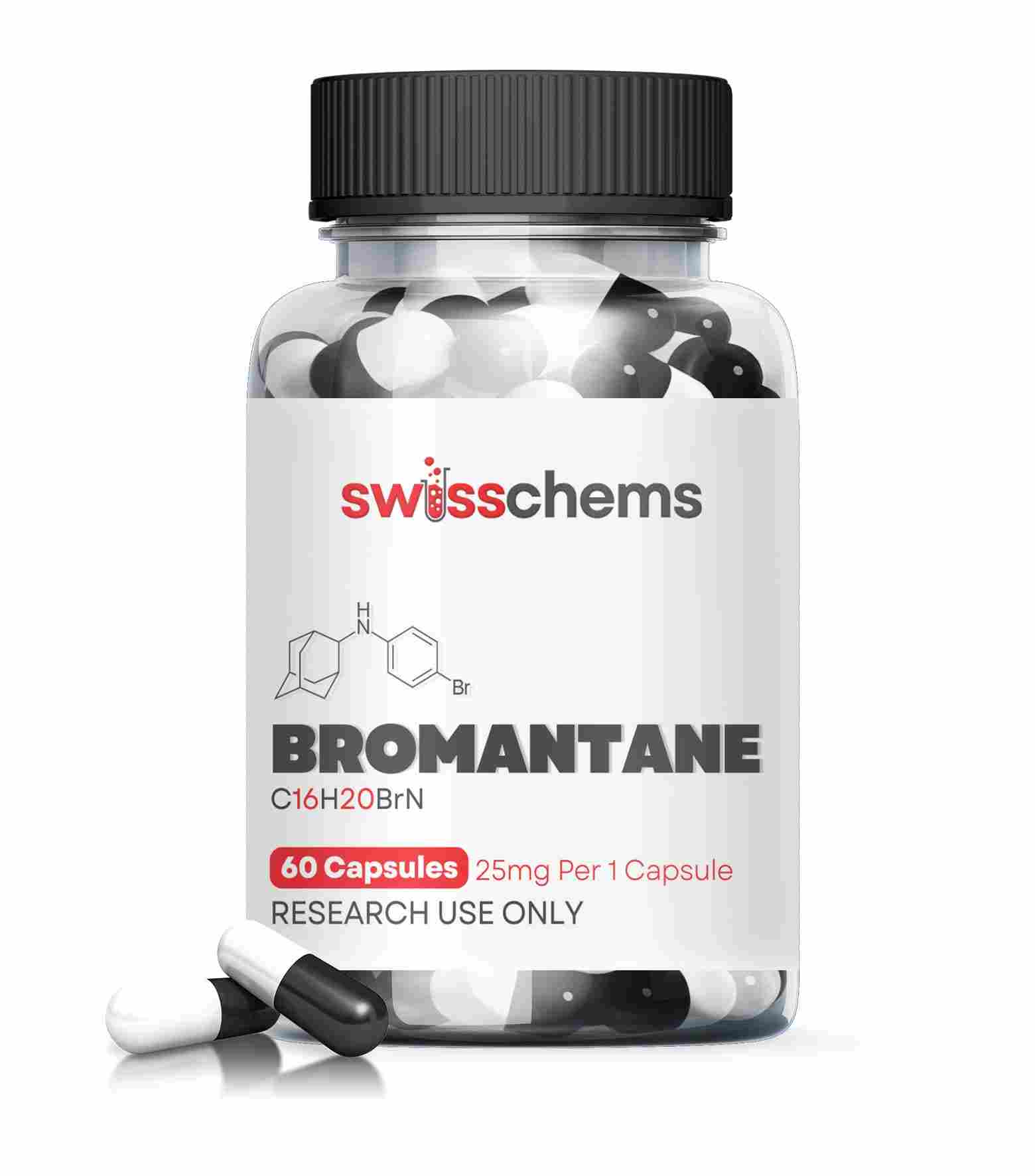
Researchers can review the current Bromantane 25mg capsule research listing available through SwissChems UK .
The product contains 60 capsules, with each capsule identified as 25mg, and is supplied strictly for laboratory and analytical research.
Researchers can also browse the nootropics research catalogue or the complete SwissChems UK catalogue .
Frequently Asked Questions
How does Bromantane work?
Bromantane’s exact mechanism is not completely established. Experimental research indicates an important relationship with dopaminergic pathways, including dopamine release, uptake and enzymes involved in dopamine biosynthesis. Serotonergic mechanisms have also been investigated.
Does Bromantane increase dopamine?
Animal studies have reported changes in dopamine-related measurements, including dopamine and L-DOPA concentrations and expression of enzymes involved in dopamine synthesis. These findings should not be simplified into a definitive statement about effects in humans.
What does tyrosine hydroxylase have to do with Bromantane?
Tyrosine hydroxylase is a key enzyme involved in dopamine biosynthesis. Animal research involving Ladasten has reported changes in tyrosine hydroxylase gene expression and related dopamine measurements.
Does Bromantane affect dopamine uptake?
A 1999 mechanistic study reported inhibition of dopamine synaptosomal uptake under the in-vitro conditions examined. This finding does not by itself establish how significant that mechanism is in humans.
Does Bromantane affect serotonin?
Experimental animal studies have reported effects involving serotonin and its metabolites as well as serotonergic uptake. The extent to which serotonin contributes to the overall mechanism remains less clearly established.
Is Bromantane’s mechanism fully understood?
No. The available research points toward dopamine-related mechanisms, with additional serotonergic effects, but the complete mechanism remains unresolved.
Where can I read more Bromantane research?
Start with our complete Bromantane guide and Bromantane research review . You can also read the Bromantane Wikipedia article for an additional external overview.
Sources for Bromantane Mechanism Research
- PubChem — Bromantane compound record
- PubMed — Effect of Bromantane on dopaminergic and serotonergic systems
- PubMed — Mechanisms of the neurotropic action of Bromantane
- PubMed — Ladasten and genes regulating dopamine biosynthesis
- PubMed — Ladasten and tyrosine hydroxylase gene regulation
- PubMed — Ladasten, dopaminergic neurotransmission and synaptic plasticity
- Wikipedia — Bromantane
Research Use Only: SwissChems UK products are supplied strictly for laboratory, analytical and research use only. They are not intended for human or veterinary consumption, therapeutic use, diagnosis or clinical administration. This article summarises published research for informational purposes and does not constitute medical advice.
