
Uncategorized
bromantane capsules vs powder
Bromantane Capsules vs Powder: Research Formats Compared
Comparing Bromantane capsules vs powder is primarily a question of research-material presentation. Both formats may contain the same underlying compound, but packaging, labelled quantities, inventory procedures and laboratory handling can differ significantly.
Capsules and powder are different formats, not different compounds.
When the underlying material is correctly identified as Bromantane, the main difference between a capsule listing and a powder listing is how the research material is presented and packaged. Researchers should compare compound identity, labelled quantity, formulation, lot information and available analytical documentation rather than assuming one format is universally preferable.
What Is the Difference Between Bromantane Capsules and Powder?
The basic distinction between Bromantane capsules vs powder is the physical presentation of the research material.
A capsule product contains research material presented in individually prepared units. A powder product typically contains material supplied in a bulk powder presentation within one container.
That difference can affect laboratory inventory, record keeping, sample allocation, packaging and the information researchers need to document when receiving a product.
It does not automatically mean that the underlying chemical identity is different.
Research material is presented in individual capsule units with a stated amount associated with each capsule and a defined unit count for the package.
Research material is presented as bulk powder, with the total labelled quantity applying to the material contained within the package.
What Are Bromantane Capsules?
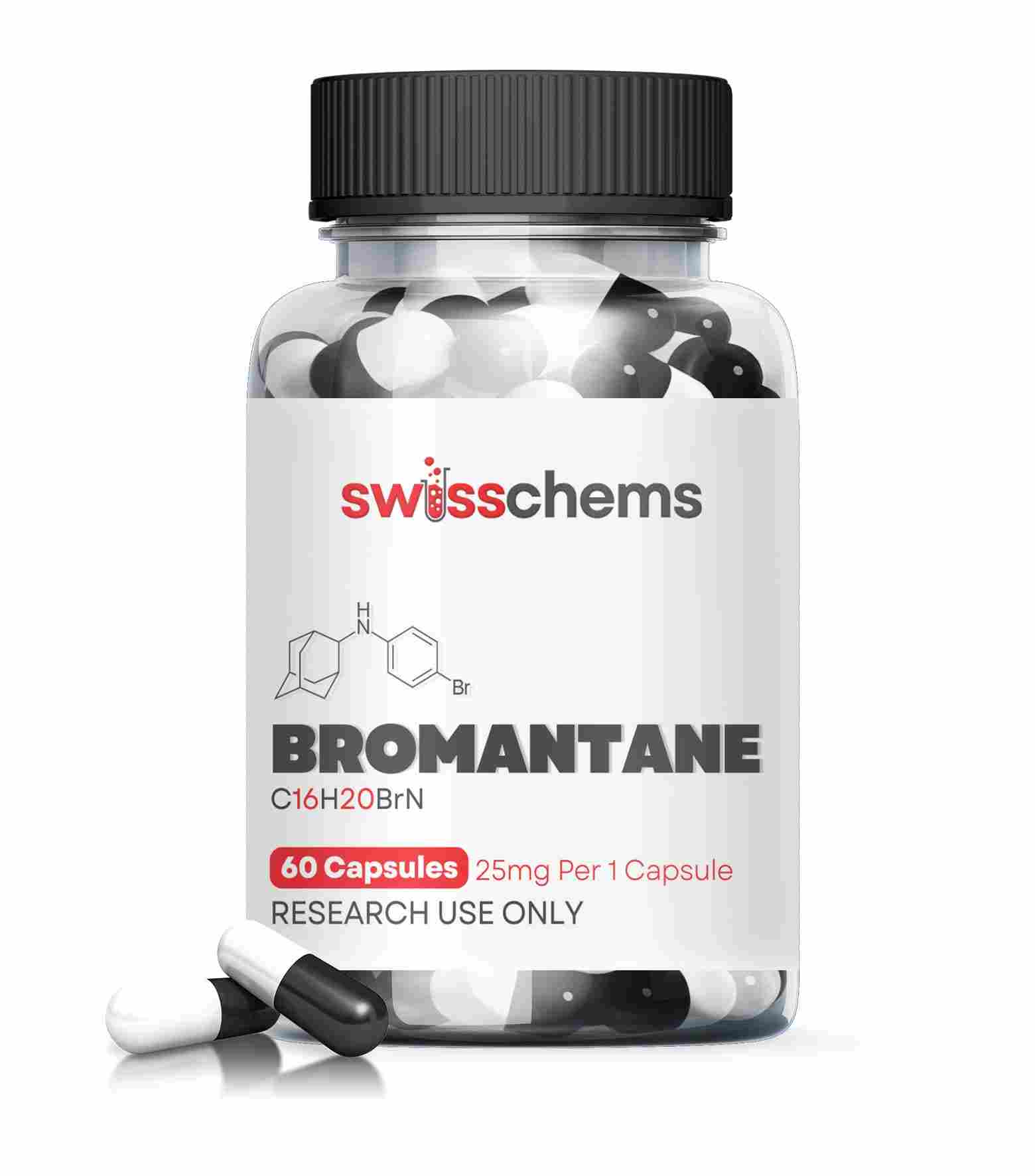
Bromantane capsules are a packaged research format in which material is divided into individual capsule units.
The current SwissChems UK Bromantane capsule listing identifies each capsule as 25mg and lists 60 capsules per package.
From a laboratory inventory perspective, this provides two immediately visible pieces of product information:
- The labelled amount associated with each capsule
- The total number of capsule units supplied
Researchers should still review the exact product label and any available batch-specific information rather than relying only on the catalogue title.
What Is Bromantane Powder?
A Bromantane powder listing presents the research material in bulk powder form rather than individual capsule units.
In this type of presentation, researchers should pay particular attention to the total labelled quantity, container identification, lot or batch number and supporting documentation associated with the exact product.
The word powder describes the physical presentation. It does not by itself confirm composition, purity, concentration, excipients or analytical specifications.
Those details should be established from the specific product label and product- or batch-specific documentation where available.
Two products carrying the name Bromantane can differ in packaging, quantity, formulation and batch documentation. Researchers should compare the exact listings being considered rather than assuming all Bromantane products are interchangeable.
Bromantane Capsules vs Powder: Side-by-Side Comparison
| Research Consideration | Bromantane Capsules | Bromantane Powder |
|---|---|---|
| Physical format | Individual capsule units | Bulk powder material |
| Quantity presentation | Often identifies both an amount per capsule and total capsule count | Usually identifies a total quantity for the container |
| Inventory counting | Individual units can be counted directly | Inventory relates to the bulk container and recorded material quantity |
| Container format | Capsule container or bottle | Bulk powder container |
| Documentation | Product name, unit amount, count and lot information should be recorded | Product name, total quantity, lot and analytical information should be recorded |
| Compound identity | Should be confirmed from the product label and documentation | Should be confirmed from the product label and documentation |
Does the Format Change the Identity of Bromantane?
Physical format and chemical identity are separate concepts.
Bromantane itself is identified in chemical databases as N-(4-bromophenyl)adamantan-2-amine, with CAS number 87913-26-6.
A correctly identified Bromantane material does not become a different chemical compound merely because it is packaged as capsules rather than bulk powder.
However, a finished capsule product may contain other formulation materials in addition to the named research compound. That is another reason laboratories should review the exact product documentation rather than infer composition solely from the headline product name.
For a general independent overview of Bromantane’s chemical identity, alternative names and history, researchers can also review the Bromantane reference page on Wikipedia.
Read Bromantane on Wikipedia →Laboratory Inventory: Capsules vs Powder
Product format can affect how a laboratory records and manages research inventory.
Recording Bromantane Capsules
For a capsule-format product, useful inventory information may include the product name, stated amount per capsule, total capsule count, received quantity, lot number and supplier information.
Recording Bromantane Powder
For a powder-format material, useful records may instead emphasise the total labelled quantity of material, container identifier, lot or batch number and associated analytical documentation.
Laboratories should follow their own validated inventory and sample management procedures rather than relying solely on a supplier’s website.
Why Batch Documentation Matters More Than Format
When comparing Bromantane capsules vs powder, physical format is easy to see. Analytical quality is not.
Researchers should therefore avoid assuming that a capsule or powder presentation is inherently higher quality simply because of its format.
More meaningful questions include:
- Is the compound clearly identified?
- Is there a batch or lot identifier?
- What quantity does the current label state?
- Is product- or batch-specific analytical information available?
- Does the received material correspond with the ordering information?
These checks provide a stronger research-product evaluation framework than judging quality from packaging alone.
Which Bromantane Research Format Should a Laboratory Choose?
There is no universal answer.
The appropriate research format depends on the laboratory’s intended workflow, inventory system, documentation requirements and the exact material needed for the planned analytical work.
A laboratory that values clearly separated individual units may prefer the organisational characteristics of a capsule presentation.
A laboratory whose workflow requires a bulk research material may instead look for a powder presentation.
The decision should be based on the research protocol and product specifications rather than assumptions that one format is inherently superior.
Is Bromantane Capsule Material the Same as Bromantane Powder?
This question requires careful wording.
Both products may identify Bromantane as the underlying research compound, but a capsule is a finished product format and may include additional formulation materials.
Researchers should therefore not assume that the entire physical contents of a capsule are compositionally identical to a standalone bulk powder material.
Product-specific labels and analytical documentation should be used when exact composition matters.
Compare compound identity first, product formulation second and physical format third. “Capsule” and “powder” describe presentation; they do not substitute for proper product documentation.
Continue Exploring Bromantane
This article compares Bromantane capsules vs powder. Continue through our research hub for compound identification, published research, Ladasten terminology and proposed mechanisms.
Bromantane Capsules at SwissChems UK
SwissChems UK currently lists Bromantane 25mg capsules, 60 capsules within its nootropics research catalogue.
Researchers comparing Bromantane formats can also browse the SwissChems UK nootropics collection or check the complete research catalogue for currently available product formats.
Product availability can change, so the individual product page should be treated as the primary source for current format and quantity information.
Bromantane Capsules vs Powder FAQ
What is the main difference between Bromantane capsules and powder?
The main difference is physical presentation. Capsules contain material presented in individual units, while powder is supplied as bulk material in a container.
Is Bromantane different when supplied as capsules?
The named research compound may be the same, but a capsule is a finished formulation and may contain additional formulation materials. Researchers should review the exact product documentation.
Are Bromantane capsules easier to inventory?
Individual capsule units can provide a straightforward unit count for inventory purposes. Whether this is preferable depends on the laboratory’s own research and inventory procedures.
What should researchers check on a Bromantane powder listing?
Review the exact compound identity, total labelled quantity, product format, batch or lot information, supplier details and available analytical documentation.
Does powder mean the material is purer than capsules?
No conclusion about purity should be made solely from physical format. Purity or composition requires appropriate product- and batch-specific analytical information.
Where can I find Bromantane capsules from SwissChems UK?
Researchers can review the current Bromantane capsule listing , which identifies 25mg per capsule and 60 capsules per package.
Where can I find other Bromantane formats?
Check the SwissChems UK nootropics category and current research catalogue for presently available formats.
Bromantane Reference Sources
Research Use Only: SwissChems UK products are supplied strictly for laboratory, analytical and research purposes and are not intended for human or veterinary consumption, therapeutic use, diagnosis or clinical administration. This article discusses research-product formats and does not provide medical or personal-use guidance.
