
Uncategorized
bromantane nootropic
Is Bromantane a Nootropic? Classification and Research Explained
The phrase Bromantane nootropic appears frequently in online discussions and research-product catalogues. But is Bromantane scientifically classified as a nootropic, a stimulant, an actoprotector or something else?
Bromantane is often discussed as a nootropic, but that is not its only classification.
Bromantane is commonly grouped with nootropic compounds in modern research catalogues and online discussions. However, PubChem more formally describes Bromantane as a central nervous system stimulant and a derivative of 2-aminoadamantane. Scientific literature has also discussed Bromantane as an actoprotector. The word “nootropic” therefore describes only one way the compound is commonly discussed rather than a complete scientific classification.
Is Bromantane a Nootropic?
Bromantane is frequently described online as a nootropic, and researchers browsing modern specialist catalogues will often find Bromantane placed within nootropics categories.
However, classification is more complicated than simply assigning Bromantane one label.
The U.S. National Library of Medicine’s PubChem database describes Bromantane as a derivative of 2-aminoadamantane and a central nervous system stimulant.
Scientific reviews have also discussed Bromantane as an example of an actoprotector.
Therefore, describing Bromantane as a nootropic reflects one modern usage of the term, but it should not be interpreted as its only or definitive pharmacological classification.
Chemical databases, pharmacology papers, research catalogues and online communities may classify the same compound differently. Researchers should distinguish formal chemical or pharmacological descriptions from broad commercial categories.
What Does “Nootropic” Mean?
The term nootropic is generally used for substances discussed or investigated in relation to cognitive processes such as learning, memory, attention or other aspects of neurological function.
In modern online usage, the term has expanded considerably and may be applied to a wide range of compounds with very different chemical structures and mechanisms.
As a result, a website category labelled “nootropics” does not mean that every compound inside that category belongs to one formal pharmacological class.
Bromantane illustrates this distinction particularly well.
How Is Bromantane Scientifically Classified?
PubChem’s current Bromantane compound record identifies it as N-(4-bromophenyl)adamantan-2-amine.
Its molecular formula is C16H20BrN, its CAS number is 87913-26-6, and PubChem identifies it as an adamantane-derived CNS stimulant.
PubChem also includes classifications associated with psychotropic substances and central nervous system activity.
Bromantane is structurally related to the adamantane family of compounds.
PubChem describes Bromantane as a central nervous system stimulant.
Scientific reviews have discussed Bromantane among compounds described as actoprotectors.
Bromantane is frequently grouped within nootropics research catalogues and online research discussions.
Is Bromantane a Stimulant?
Yes, Bromantane is described as a central nervous system stimulant in major chemical databases.
This is one reason it is useful to be careful when using the phrase Bromantane nootropic. The nootropic label does not replace Bromantane’s stimulant classification.
Bromantane has also been described in scientific literature as pharmacologically unusual compared with more familiar traditional stimulants.
Experimental research has investigated effects involving dopamine biosynthesis, dopamine uptake and gene regulation rather than reducing its mechanism to one simple stimulant pathway.
You can explore these proposed mechanisms in our guide to how Bromantane works .
Is Bromantane an Actoprotector?
Bromantane has also been discussed in scientific literature as an actoprotector.
A review indexed by PubMed describes actoprotectors as a group of compounds investigated for increasing stability under physical loads without a corresponding increase in oxygen consumption or heat production.
That review identifies Bromantane and bemitil among principal representatives discussed within the actoprotector literature.
The term is much less familiar to most consumers than “stimulant” or “nootropic”, which may help explain why Bromantane is more commonly labelled a nootropic on modern websites.
The existence of an actoprotector classification in scientific literature should not be interpreted as evidence that Bromantane is appropriate for personal, athletic or performance-enhancement use. This article discusses terminology and research history only.
Why Is Bromantane Discussed in Nootropic Research?
One reason Bromantane attracts attention in nootropic discussions is its relationship with the dopaminergic system in experimental research.
Published animal studies have investigated Bromantane in relation to:
- Dopamine release and metabolism
- Dopamine uptake
- Tyrosine hydroxylase
- DOPA-decarboxylase
- Genes involved in dopamine biosynthesis
- Dopamine-dependent neuronal signalling
Dopamine participates in many neurological functions, which makes compounds interacting with dopaminergic pathways of interest to neuroscience researchers.
However, these findings should not be transformed into unsupported conclusions about cognitive enhancement in humans.
Read our detailed Bromantane research review for a closer look at the underlying studies.
Bromantane Classification Compared
| Classification | Does It Apply? | Context |
|---|---|---|
| Adamantane derivative | Yes | Describes Bromantane’s chemical family and structure. |
| CNS stimulant | Yes | PubChem and other scientific sources describe Bromantane as a central nervous system stimulant. |
| Actoprotector | Used in scientific literature | Bromantane is discussed among principal actoprotector compounds in pharmacological reviews. |
| Nootropic | Commonly used broader term | Frequently used in research catalogues and modern discussions, but it does not fully describe Bromantane’s pharmacological classification. |
| Peptide | No | Bromantane is not a peptide. It is an adamantane-derived small molecule. |
Is Bromantane a Peptide?
No. Bromantane is not a peptide.
Peptides consist of amino acids connected through peptide bonds. Bromantane instead has the molecular formula C16H20BrN and an adamantane-derived chemical structure.
This distinction matters when organising research products because the word nootropic describes a broad research category rather than a chemical structure.
For an additional external overview of Bromantane’s chemistry, stimulant classification, Ladasten name and research history, see the Bromantane article on Wikipedia.
Read Bromantane on Wikipedia →Why Does SwissChems List Bromantane Under Nootropics?
Research catalogues often use broad categories to help visitors locate related compounds.
At SwissChems UK , Bromantane is included within the nootropics research collection .
This catalogue placement helps organise compounds associated with neurological and cognitive research interests.
It should not be interpreted as changing Bromantane’s chemical identity or replacing the classifications used by scientific databases.
Is “Bromantane Nootropic” Scientifically Accurate?
The phrase is useful as a broad search and catalogue term, but it needs context.
Calling Bromantane a nootropic does not necessarily mean that major scientific databases formally classify it using that exact term.
A more complete description would be:
Bromantane is an adamantane-derived CNS stimulant that has also been discussed as an actoprotector and is commonly grouped with nootropic research compounds.
This phrasing better reflects the differences between chemical identity, pharmacological classification and modern catalogue terminology.
Bromantane vs Traditional Nootropic Classification
The broad modern nootropic category contains compounds with very different structures and proposed mechanisms.
Some are investigated primarily in relation to memory or learning. Others interact with cholinergic, glutamatergic or monoaminergic systems.
Bromantane’s research history is distinctive because it combines discussions of stimulant activity, dopaminergic mechanisms and actoprotector research.
This makes it difficult to describe the compound accurately using only one broad category.
“Bromantane nootropic” is a commonly used modern description, but Bromantane is more specifically identified as an adamantane-derived CNS stimulant and has also been discussed as an actoprotector in scientific literature.
Continue Exploring Bromantane
Explore Bromantane’s identity, published studies, Ladasten terminology, proposed mechanism and available research formats throughout our complete research series.
Bromantane Research Products at SwissChems UK
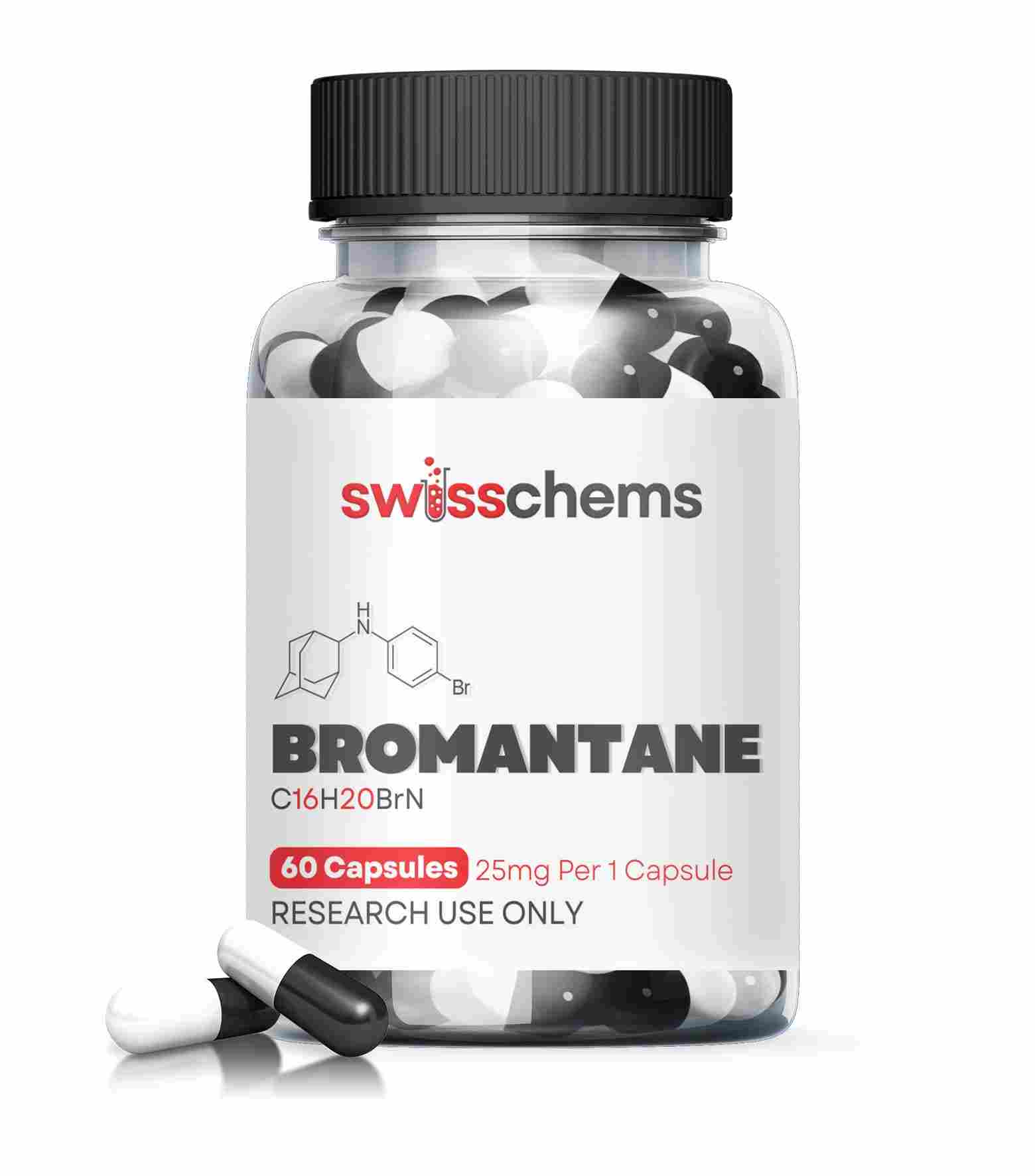
Researchers can review Bromantane 25mg capsules, 60 capsules through SwissChems UK .
The product is currently organised within the SwissChems UK nootropics research collection and is presented strictly for laboratory and analytical research.
Researchers can also browse the complete SwissChems UK catalogue for additional research products and formats.
Frequently Asked Questions
Is Bromantane a nootropic?
Bromantane is frequently grouped with nootropic research compounds and discussed using that term. However, PubChem more specifically describes Bromantane as an adamantane-derived central nervous system stimulant. Scientific literature has also discussed it as an actoprotector.
Is Bromantane a stimulant?
Yes. PubChem identifies Bromantane as a central nervous system stimulant.
Is Bromantane an actoprotector?
Bromantane has been discussed as an actoprotector in scientific literature. A pharmacological review of actoprotectors identifies Bromantane among the principal compounds associated with this research category.
Is Bromantane a peptide?
No. Bromantane is an adamantane-derived small molecule with the molecular formula C16H20BrN. It is not a peptide.
Why is Bromantane included in nootropics catalogues?
Nootropics is often used as a broad catalogue category for compounds associated with neurological and cognitive research. Catalogue placement does not replace a compound’s formal chemical or pharmacological classification.
Does Bromantane affect dopamine?
Experimental research has investigated Bromantane in relation to dopamine release, metabolism, uptake and enzymes involved in dopamine biosynthesis. Most mechanistic findings should be interpreted as preclinical research rather than proof of specific human outcomes.
Where can I learn how Bromantane works?
Read our Bromantane mechanism of action guide and our Bromantane research review for a closer examination of the published literature.
Bromantane Classification Sources
Research Use Only: SwissChems UK products are supplied strictly for laboratory, analytical and research purposes. They are not intended for human or veterinary consumption, therapeutic use, diagnosis or clinical administration. This article discusses scientific classification and published research for informational purposes and does not constitute medical advice.
